- Education, Table Rock Lake, Water Quality

Picture 800 million gallons of water – what does that look like? It’s enough water to fill the University of Arkansas or Missouri University’s entire football stadium over 5 times! It’s enough water to meet the daily needs of 7 million people – more than the entire population of Missouri. It’s also roughly how much water datacenters use every day across North America. Of the roughly 4,000 datacenters in the US, approximately a quarter power artificial intelligence.
Numbers that large are hard to fathom – but context matters. How does AI’s water use actually stack up against the other demands of our everyday lives?
In our last article, we discussed how an AI datacenter uses water — mainly through evaporative cooling that consumes water and returns very little to the source in the local community. AI datacenters also disproportionately put pressures on these local communities, especially when built in water-scare regions without plentiful resources. It’s challenging to estimate how much water it uses, though, and estimates can vary wildly. This is because there are different ways to measure water use, specifically whether centers are measuring direct vs indirect water use.
Direct water use measures all the water used onsite. In your home, this is the water running from your faucets, showers, toilets, and appliances. In a datacenter, direct water is mostly used in evaporative cooling technology.
Indirect water use measures the water used for materials or services before they reach the main site. You never see this water, but it was used for everything from growing your food, making the clothes we wear, or generating the power we use in our daily lives. In AI datacenters, a significant amount of indirect water is used to manufacture the chips that power AI servers.
This distinction is significant, because a huge portion of the water we use is this “invisible” water use, both in AI datacenters and in everyday life. In 2025, the International Energy Agency estimated that a 100-megawatt hyperscale datacenter in the United States consumes around 500,000 gallons of water per day — equivalent to about 6,500 households — and more than 60% of that figure comes from indirect use. When large companies with AI datacenters disclose their energy and water use, they may only be reporting their direct use, which can hide the true cost. For example, a leaked document found that a popular online retailer discussed strategies for obscuring the true water cost for their AI datacenters from public reporting. If we are going to continue developing datacenter technology, it’s imperative that decision makers and the public have access to clear, comprehensive data that allows us to make informed decisions.
All of this makes numbers hard to pin down and understand. Market research estimates that all datacenters in North America used roughly 264 billion gallons in 2025, or about 800 million gallons per day (MGD). This technology is still emerging, which means these numbers may change over time, as more information comes to light.
But to understand what those numbers really mean, we first need to understand how the United States uses water in the first place.
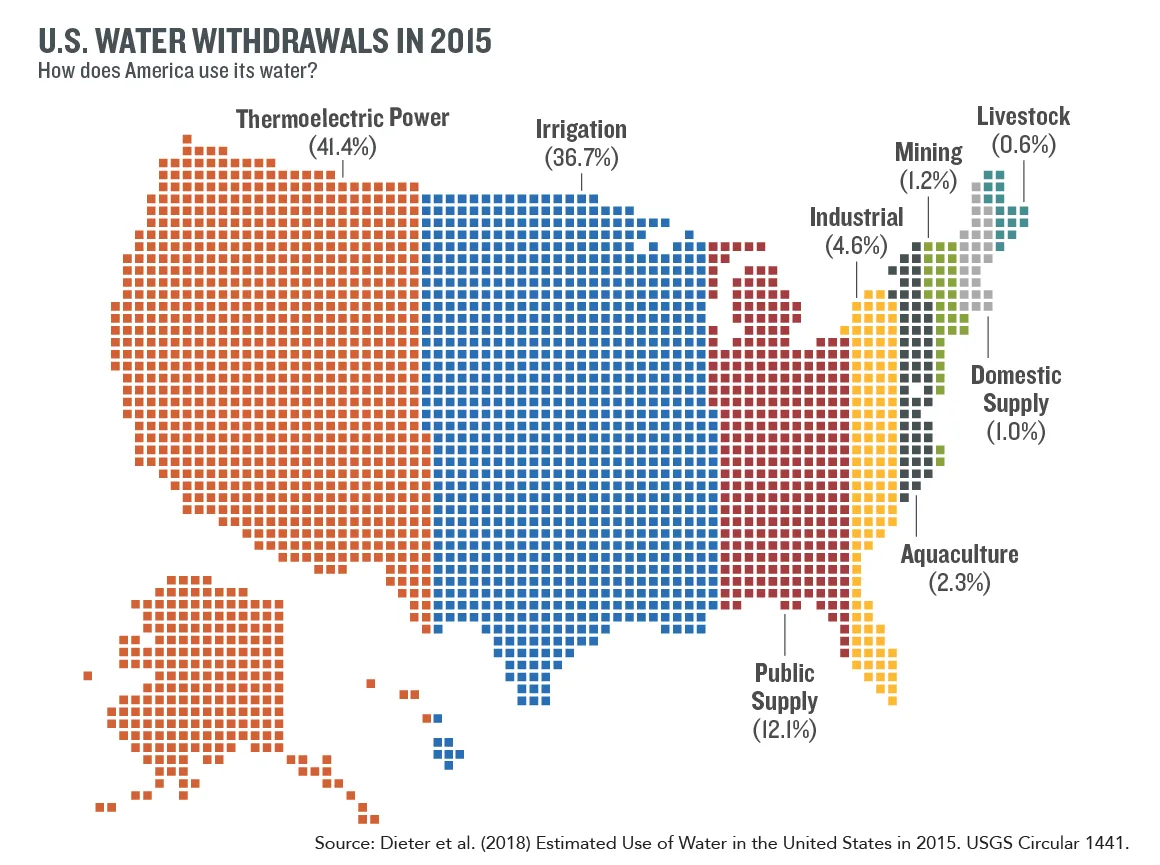
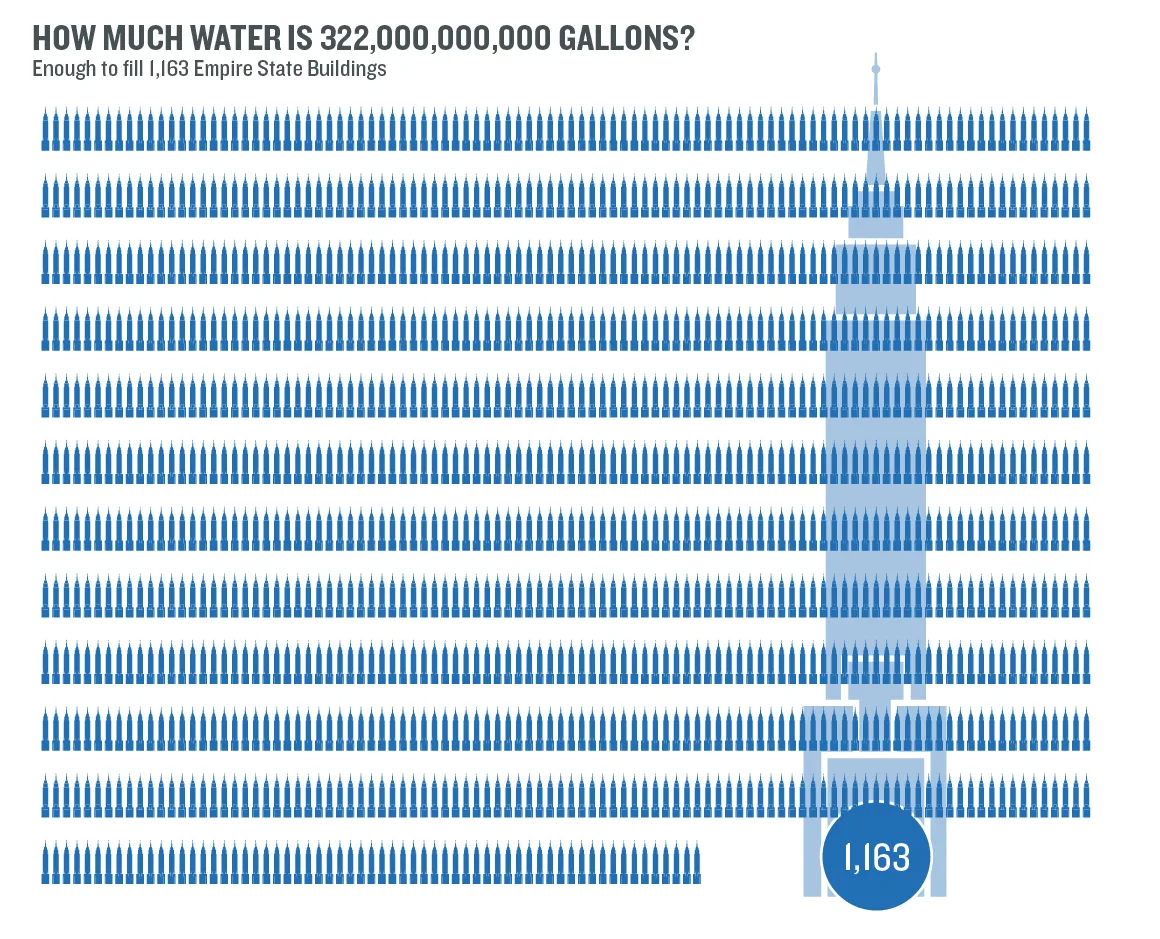
The US Geological Survey (USGS) estimates that the total water use in the US is around 322 billion gallons per day.
The two largest categories are thermoelectric power and irrigation, accounting for about 78% of all the water used in the the country! In contrast, public water supply (what comes out of your taps) is only about 12%.
In other words, most of the water used every day in the US is water most of us will never directly see or touch. These are broad categories — the water used by datacenters falls under both thermoelectric and industrial use, since it needs electricity to power the servers.
So what do we get for it? Thermoelectric power plants — which generate electricity by heating water to create steam to spin turbines — keep our homes, businesses, and communities running. Irrigation grows the crops that feed us, although some is also used to water our lawns, golf courses, parks, and nurseries. The EPA estimates that Americans use about 9 billion gallons of water per day on landscape irrigation alone. Golf courses use about 1.3% of irrigation water use the US, or approximately 1.5 billions gallons per day.
Water’s invisible footprint extends into almost everything we consume. The average American household uses around 300 gallons of water per day directly, but our daily activities carry hidden water costs far beyond that. Many of our activities – like driving a car, eating food, and shopping – have hidden, indirect water costs as well. For example, refining one gallon of gasoline requires 1–2.5 gallons of water. Manufacturing a single pair of jeans uses approximately 2,866 gallons. Producing one pound of beef requires around 1,852 gallons of water! If you’re curious, you can measure your water footprint and see how much water is used in other daily activities.
These comparisons are not to say that any one use of water is inherently “good” or “bad”, but rather, that they all have a measurable cost. Additionally, a national-scale comparison can be misleading when it comes to AI datacenters. As discussed in our first article, AI datacenters have a significant impact on the local level. When datacenters are built in regions that lack the water resources or infrastructure to support them, it can cause disproportionate negative impacts on these local communities.
And when we have a finite amount of water, what costs are truly worth it?
Viewed against the full scale of US water consumption, datacenters’ 800 MGD is significant, but not dominant. AI is an extremely powerful technology. It has revolutionized many industries and has led to new breakthroughs in medicine and science. At the same time, there are many uses of AI that could be considered frivolous, like generating AI videos of cats. While AI datacenters are a new concern, the reality is that the activities we take are not free. Everything has a resource cost, and we must be responsible with these limited resources.
The total accessible freshwater supply in the entire world amounts to less than 1% of all water on Earth. The way we manage this finite and precious resource is increasingly crucial as new technologies, changing landscapes, and increasing pressures shape our water use. It’s up to us to be responsible stewards of our water and choose how we want to allocate these resources for the betterment of us all.
So how can we be responsible stewards of our water? What actions are being taken on the local, regional, and national stage to manage this developing new technology and ensure we can responsibly support both our local communities and investment in technologies? That’s where we will pick up our third and final installment in this series. Click here to continue reading.