- Education, Table Rock Lake, Water Quality

As Artificial Intelligence (AI) use expands across the country, conversations about the environmental impacts of this technology are growing alongside it. The generative AI market is growing around 30% a year and is projected to increase from $103 billion in 2025 to nearly $1 trillion in 2032. To fuel this explosive growth, AI datacenters are popping up across the county, and are consuming significant amounts of energy and water along the way. In the Ozarks, there is AI datacenter development in Conway and Pulaski county in Arkansas, and increasing buildout in Kansas City, Missouri, which is already a major hub for datacenters.
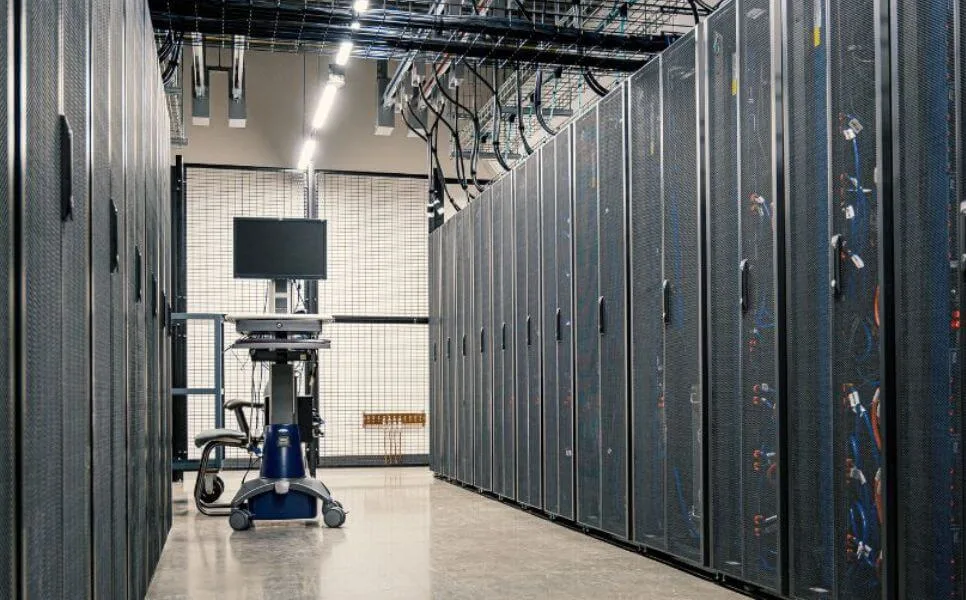
Datacenters are large facilities that house servers, networking equipment, and storage systems that companies use to run applications, host services, and manage their data. While datacenters aren’t new, the growth of datacenters specifically for artificial intelligence has significantly changed the computing landscape. AI datacenters are full of servers that run billions upon billions of highly complex and energy-intensive computations simultaneously. This requires massive amounts of electricity and water to maintain these servers. While AI’s electricity demand makes intuitive sense, the idea of AI “using water” is more difficult to understand. Conversations about AI’s water use are highly complex and range across many topics, including industrial processes, resource management, and protecting water quality.
This three-part series aims to explain 1) how AI datacenters use water, 2) how much water AI datacenters use compared to other ways we use water across the country, and 3) what policies could shape datacenters and water resource consumption moving forward. Our aim is to help readers better understand these complex concerns, why it matters for our water resources, and what actions we can take.
Because datacenters are full of servers constantly running highly complex computations, the infrastructure and chips can become overheated. To protect this equipment and keep it running efficiently, facilities must continuously cool the system. One of the most common methods is evaporative water-cooling, which works much like sweating does for humans – water absorbs heat from the equipment, turns into vapor, and carries that heat away from sensitive equipment.

As the name suggests, most of the water used in evaporative cooling is lost through evaporation, with an estimated 80% of water being “consumed” or evaporated out, rather than being recycled back through the cooling system, although this varies considerably by system design and location. While that water vapor eventually reenters the water cycle through precipitation, it likely won’t return to the same watershed or community it was sourced from.
Some estimates state that on average, a 100 MW hyperscale datacenter in the United States consumes around 2 million liters (or 530,000 gallons) of water per day in total – equivalent to about 6500 households’ use. When water is being drawn out at massive scales like those of datacenters, this demand can become unsustainable. A datacenter in Mansfield, Georgia has depleted groundwater resources from local homeowners, and in The Dalles, Oregon, a lawsuit revealed a Google hyperscale datacenter consumes over a quarter of all the water used in the city.
While water cooling is common across many heavy industries — power plants, manufacturing facilities, and steel mills all rely on similar methods — what sets datacenters apart is where they get their water. Unlike industrial facilities that often draw directly from rivers, reservoirs, or dedicated industrial water systems, datacenters may rely on municipal water supplies to meet their cooling needs. Loudoun County in Virginia, a hotspot with over 200 datacenters, used 900 million gallons of water in 2023. They relied primarily on potable or treated drinking water from the local water utility.
Municipal water, or treated drinking water, is the same supply that flows from your tap (unless you’re on private well water). Treating the raw water that comes out of a lake or reservoir to drinking-safe standards requires time, labor, and infrastructure by local utilities. When datacenters draw from these drinking water sources at the scale of large industrial factories, they may end up competing with residential and commercial users for a finite resource that took considerable public investment to produce. It is a resource-intensive process for a water supply that will end up ultimately evaporating back into the water cycle, unlikely to even return to its original watershed or source.
After datacenters use this water, the story doesn’t end cleanly. While most water that evaporates is lost from the local system entirely, the water that remains cannot simply be returned. Water used for cooling is now artificially warmed to temperatures from 30-70°C (86°F to 158°F), which ranges way hotter than the average hot tub. Discharging it at elevated temperatures can cause thermal pollution if it is returned to rivers or streams. This disrupts aquatic ecosystems and can be harmful to aquatic life. Additionally, water that passes repeatedly through cooling infrastructure can build up minerals, salts, and traces of treatment chemicals, like chlorine, to where it must receive additional treatment to be considered safe to discharge back into the environment.
While AI is used across the globe, the impacts of their datacenters are felt locally. AI requires substantial amounts of resources in very localized regions that may not be equipped to handle the demand from datacenters. Datacenters in Texas have overdrawn groundwater resources, causing the water table to drop. Rural residents are losing access to the wells that provide their household water as a result.
Geography adds another layer of concern. Many of the largest datacenter clusters are being built in water-scarce regions of the American West and Southwest, drawn by cheaper land, tax incentives, and, in some cases, access to solar energy. But arid regions are precisely the least equipped places to absorb large scale water demands. It’s estimated that 65% of new datacenter buildouts are in water-stressed regions, like Texas, Arizona, and Utah. Building in colder climates could theoretically reduce cooling water needs — since cold air can replace the need for cool water — but they may lack the solar energy potential and grid infrastructure that make development cost-effective. Developers are weighing the tradeoffs between energy economics and water sustainability with no clear answer.
One of the most significant challenges in understanding AI’s water impact is the lack of available information – many companies do not publicly disclose comprehensive water consumption data, and the metrics that are reported aren’t always consistent or comparable. While we focused this article on discussing the direct water use of datacenters, there are indirect water uses, like thermoelectric power generation, or for chip manufacturing. What we do know is that the numbers are not small. A single AI datacenter may use around 530,000 gallons every day, which is comparable to the use of about 6,500 households.
So what is a million gallons of water? The number is so large it can be difficult to fathom. To understand what that scale of water consumption means — and whether it’s a manageable tradeoff or a serious threat to local water security — it helps to place it alongside the other ways we use water every day. The next article in this series will explore how datacenters’ water consumption stacks up against agriculture, industry, and residential use, and what that comparison tells us about the priorities we may have to decide on as a society. Click here to continue reading.